
NUM Convention 2026
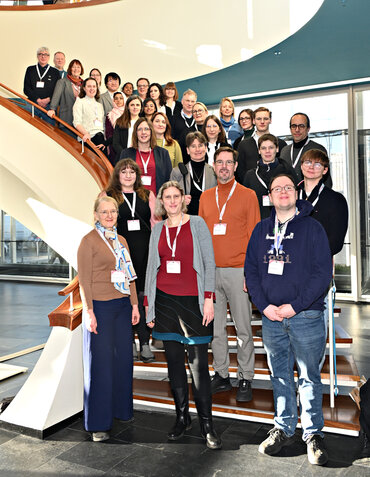
For the third time in a row, actors from research, clinics, politics and industry came together on January 21 and 22, 2026 at the Berlin Congress Center under the motto “The NUM 3.0: On the way to an open and sustainable research platform”.
Employees in the Clinical Collaborative Research team at the Department of Medical Informatics were represented at the Network University Medicine (NUM) conference in Berlin with keynote speeches and workshops, among other things.
This session offered the opportunity to get to know central service and support offers in the NUM along the entire research process and to directly exchange ideas with the service points involved. Three main topics were presented in keynote speeches:
1. Presentation of the NUM Study Network (NUM SN) and the tasks and interfaces of the first point of contact to the specialist and organ-specific working groups (FOSA) as well as to the specialist networks of NUM SN.
2. The services offered by NUM Clinical Epidemiology and Study Platform (NUKLEUS) and NUM Methods and Biosamples Hub (NUM-MB) were presented along the entire research process – from the idea to the publication – and illustrated by case studies in a practical way with advice and support services for study projects.
3. Research opportunities with health insurance, cancer and civil registry data as data close to care and presentation of the NUM research infrastructure Data acceptance and processing center for external data (DAAeD) for making it available and the advisory services for using this data within the framework of NUM-MB.
Afterwards, the participants deepened the content at topic tables in the World Café format.
The precise recording of the patient's perspective using Patient-Reported Outcome Measures (PROMs) is rapidly gaining in importance in research and clinical care. This practical workshop provided a concise and well-founded overview of the relevance of patient-reported outcomes (PROs) for patient-centered research and the use of PROMs as measurable study endpoints. Using examples from the cross-sectoral and population-based NAPKON platforms, the practical implementation and central experiences ("Lessons Learned") were shown.
As a central platform, the NUM SN study portal is intended to map the life cycle of studies and link the necessary tools. For this goal, it is essential to understand the requirements and workflows of the users and to include them in the development.
The life cycle of a study was examined in detail during the workshop. The focus was on the question of which key functions are particularly relevant for daily work in the study context and which specific requirements arise in the respective phases. The aim was to gain a clear understanding of which specialist applications and tools are needed at which point in time in order to derive an optimal design of the data flows between the systems involved in the further development process.
This session presented the registers funded by NUM from February 2026: "NUM4Rare" (Register for Rare Diseases) and "NUM RAPID" (Register for Clinical Routine Data from Pediatric and Adult Intensive Care), as well as their collaboration with the NUM Clinical Epidemiology and Study Platform (NUKLEUS) and the NUM Data Integration Centers (NUM DIZ).